Introduction
We are past the point of debating whether AI coding agents are useful. The question now is whether the ecosystem around them matures fast enough to make them reliable at scale.
For that to happen, agents need more than raw capability — they need shared standards. Without them, every team reinvents the same wheels: how to instruct an agent, how to give it access to tools, how to make new capabilities portable across environments. The result is fragmentation: agents that are tightly coupled to a single vendor, brittle to change, and expensive to maintain.
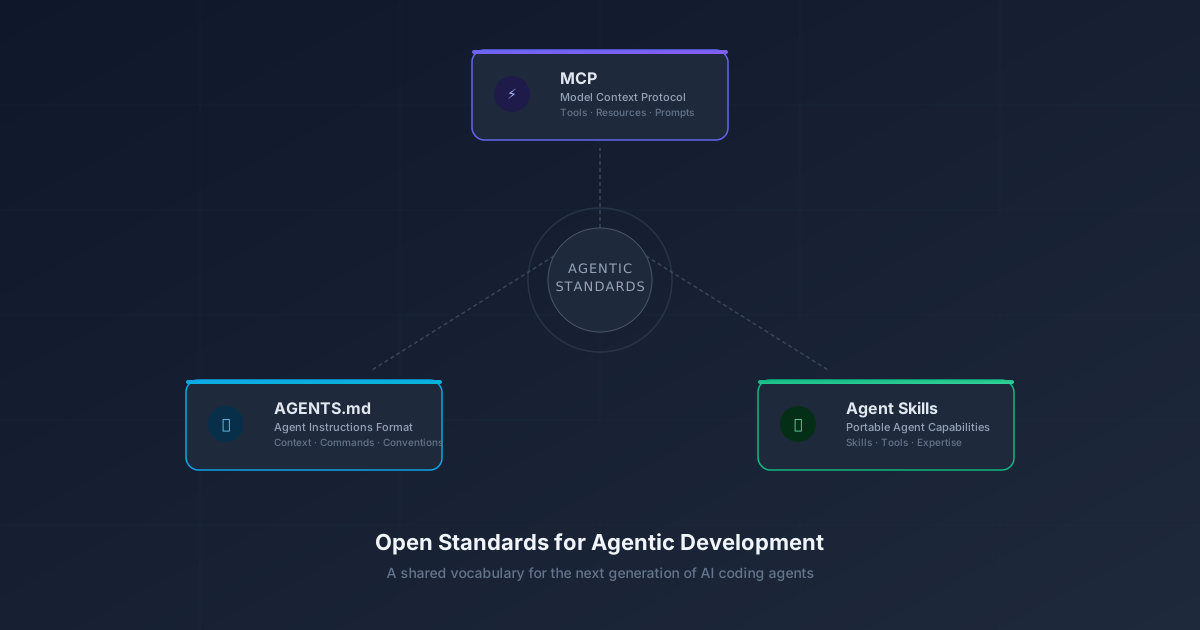
Three open standards are emerging to address this. Together, they form a coherent foundation for building agent-augmented software delivery that is interoperable, maintainable, and enterprise-ready — and because they are open, your investment in them is not at the mercy of any one vendor’s roadmap.
The Three Standards
MCP: Model Context Protocol
MCP is an open protocol that standardises how AI agents connect to external systems.
Think of it as a USB-C port for AI applications. Before MCP, every integration between an agent and an external data source or tool required custom, bespoke plumbing. MCP replaces that with a single, consistent protocol — one that AI assistants, coding agents, and IDEs can all speak.
An MCP server exposes three kinds of things:
- Resources — contextual data the agent can read (files, database records, API responses).
- Tools — actions the agent can invoke (running a query, calling an API, executing a command).
- Prompts — reusable prompt templates and workflows.
The practical impact is significant. Build an MCP server once and it works across Claude, ChatGPT, VS Code Copilot, Cursor, and any other client that supports the protocol. The integration surface shrinks from N×M (one integration per agent-tool pair) to N+M (one server, many clients).
MCP has already achieved broad adoption across AI assistants, IDEs, and development tools — making it the closest thing to an industry-standard connectivity layer for agentic systems. Because the protocol is open, an MCP server you build today works across whichever clients the ecosystem supports tomorrow.
AGENTS.md: A README for Your Agent
AGENTS.md is an open, plain-text format for giving coding agents structured, project-specific instructions.
The premise is straightforward: README.md is for humans. AGENTS.md is for agents. Rather than scattering agent guidance across proprietary configuration files, system prompts, or ad-hoc comments, AGENTS.md provides a single, predictable place where any agent can find what it needs to work effectively in a codebase.
A well-structured AGENTS.md typically covers:
- Setup commands — how to install dependencies, start services, run tests.
- Code style — conventions the agent should follow when writing or modifying code.
- Testing instructions — which test suites to run, how to interpret failures.
- Security considerations — what the agent must not do (e.g., touch production credentials).
- PR and commit guidelines — expected format for messages and branch names.
One file works across the growing ecosystem of agents that support the format, including OpenAI Codex, Cursor, Amp, Google Jules, and Factory. In larger monorepos, nested AGENTS.md files let individual packages provide tailored instructions — the closest file to the edited code takes precedence.
The format emerged from collaboration across the AI development ecosystem and is now stewarded by the Agentic AI Foundation under the Linux Foundation — a signal that this is being treated as genuine infrastructure, not a vendor-specific feature.
Used by over 60,000 open-source projects, AGENTS.md has already reached the kind of adoption that turns a format into a de-facto standard.
Agent Skills: Portable Agent Capabilities
Agent Skills is a standard for packaging agent capabilities in a way that is portable across different agents and environments.
Where MCP addresses how agents connect to tools and data, and AGENTS.md addresses how agents are instructed within a project, Agent Skills addresses a different problem: how do you give an agent a new capability — a specialised skill — without coupling that capability to a specific agent implementation?
A skill encapsulates everything an agent needs to take on a new area of expertise: the instructions, the tooling, the context, and the behaviour. Because the format is standardised, the same skill can be loaded by any compatible agent — whether that’s Cursor, Gemini CLI, JetBrains Junie, OpenHands, or any other agent in the growing ecosystem.
This matters in enterprise contexts where multiple teams may use different agents but need consistent behaviour. Rather than maintaining separate configurations for each tool, a skill is written once and reused everywhere — and because the format is open, skills can be shared across organisations or contributed back to the community.
Why Standards Matter Now
Each of these three standards solves a distinct problem:
| Standard | Problem Solved | Scope |
|---|---|---|
| MCP | How agents connect to external systems | Runtime connectivity |
| AGENTS.md | How agents are instructed within a project | Project-level context |
| Agent Skills | How agent capabilities are packaged and reused | Capability portability |
Together they form something more than the sum of their parts. MCP gives agents reach. AGENTS.md gives agents understanding. Agent Skills gives agents expertise. Stack them and you get agents that can access the right tools, follow the right conventions, and apply the right expertise — without requiring bespoke configuration for every agent, project, or team.
What This Means in Practice
For a software delivery team, adopting these standards is incremental and low-risk:
-
Start with
AGENTS.md— add one to your repository with your build commands, test instructions, and code style conventions. This immediately improves the out-of-the-box behaviour of any agent working in your codebase. -
Add MCP servers for your internal tools — if your team uses internal APIs, databases, or documentation systems, an MCP server makes them accessible to any agent in your stack without repeated custom integrations.
-
Package reusable behaviours as Agent Skills — if you find yourself writing the same agent instructions across multiple projects or teams, extract them into a skill and share them.
None of this requires committing to a single AI vendor. That is arguably the most important property these standards share: they are designed to be interoperable by default. Adopting them now means your investment in agent tooling is portable as the ecosystem evolves.
Standards as a Durable Bet
There is a useful parallel here with earlier generations of open standards. Engineers who invested in Git, SQL, HTTP, and REST found that expertise travelled further and lasted longer than equivalent investment in proprietary alternatives. Each time the ecosystem converged on an open standard, that standard became the floor everyone built on.
The same dynamic is playing out in agentic development. The agents themselves will evolve — new models, new tools, new vendors. But the standards that define how agents are instructed, how they connect to systems, and how their capabilities are packaged are where durable expertise accumulates.
That expertise also travels: experience with MCP, AGENTS.md, and Agent Skills is as relevant at your next employer as it is today, because the standards belong to the ecosystem rather than to any one product. Investing in the infrastructure layer is a more stable bet than optimising for any one tool sitting on top of it.
Conclusion
The agentic era of software development is not coming — it is already here. What determines whether it succeeds at scale is not the capability of any individual model or tool, but whether the ecosystem develops the shared infrastructure that makes agents predictable, maintainable, and interoperable.
MCP, AGENTS.md, and Agent Skills are that infrastructure. They are open, broadly adopted, and actively maintained — and not owned by any one vendor. Adopting them now means your investment in agent tooling remains portable as the ecosystem continues to evolve.
The agentic development ecosystem is consolidating around these standards now. This is the right moment to build on them.